The Unbroken Tradition Is Often a Story We Tell
An unbroken tradition is rarely unchanged. Learn to distinguish repeated practice, adaptation and later retelling when tracing a custom’s history.
How can you tell whether an unbroken tradition has really stayed the same? Usually, you cannot—and that is not a reason to dismiss it. A custom may have persisted because people repeated it, while its materials, purpose and meaning shifted along the way. The history lies in both the practice and the changes that helped it endure.
This distinction matters especially in northern communities, where seasonal gatherings, household customs and local ceremonies can connect people across long distances and generations. The claim that a custom is “unchanged” often compresses several different histories into one tidy phrase. A more useful account asks what was repeated, what was altered, and when people began describing the custom as ancient or continuous.
Repetition and continuity
Repetition is the most direct kind of continuity: people keep performing an action, perhaps at a familiar season or gathering. But repetition does not mean every part remains fixed. A communal meal might still be held after harvest even as the food, venue, attendees and reasons for meeting change.
It helps to separate the custom into parts. Consider its timing, actions, objects, participants, setting and stated purpose. Some parts may persist while others change. The practice can feel recognisable across generations without being identical in every detail.
That is rather like a wooden chair repaired over time. Its outline and use remain familiar, although a replaced rung or a new coat of paint records changes in its life. Calling it the same chair is reasonable; claiming that no part has changed is not.
Continuity can also be interrupted and resumed. A custom may fall out of use in one setting, survive in family memory, then return through a community group or local institution. In that case, the present practice may connect with an earlier one without having passed through every generation in an uninterrupted line.
Adaptation within practice
Adaptation is not simply evidence that a tradition has failed to survive. It can be the means by which people keep a familiar practice workable. Weather, available materials, work patterns, migration and changes in who takes part can all prompt adjustments. A custom may retain a recognisable sequence while accommodating new circumstances.
For a shared history, the question is not just whether an alteration occurred, but who made it and how they understood it. A change introduced by participants to include new neighbours has a different meaning from one imposed by an outside organiser. Both may affect the practice, but they tell different stories about local choice and authority.
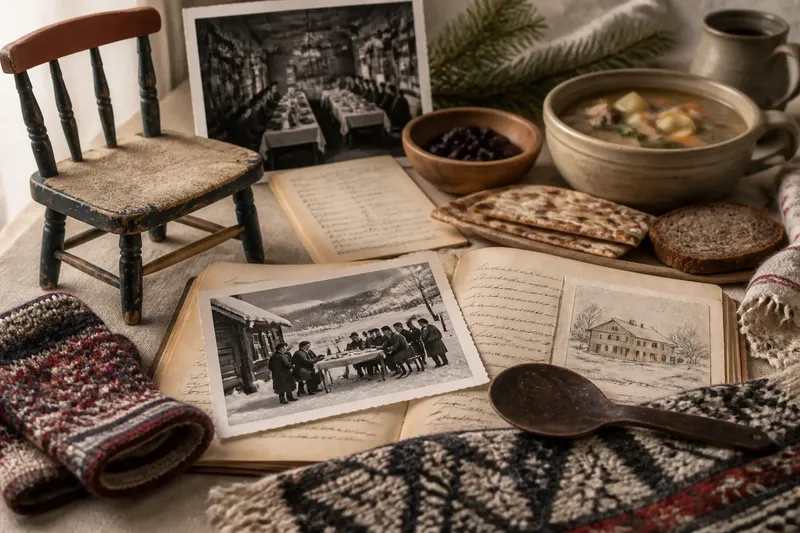
Say a northern village holds a winter gathering around a shared meal. Imagine that fuel becomes harder to obtain, so organisers move the event indoors and invite households who once took no part. The expected observable result is a gathering that keeps its seasonal meeting and shared meal, while its setting and membership change. It would be misleading to call every detail unchanged; it would also miss the point to say that nothing meaningful continued.
Details often provide better evidence than broad claims. A handwritten programme, a household account, a photograph or a remembered recipe may show one feature at a particular moment. Compare such records cautiously: an image can show what was arranged for a camera, while a recipe may preserve ingredients but say little about when or by whom a dish was served.
Retelling the past
A community’s account of a custom is itself part of its history. People may describe a practice as ancient, unchanged or uniquely local because those words express belonging, not because they have assembled a complete record. Later retellings can make a tradition easier to explain and pass on, while smoothing over periods of change.
That does not make the account worthless. It means the account should be read on two levels: as a claim about past practice, and as evidence of what the custom means to people now. The moment when a custom began to be called “unbroken” may reveal a new concern with identity, continuity or public recognition.
Retellings can also settle which version becomes familiar. A school programme, museum display or local booklet may select one set of details as representative. Other versions—perhaps tied to different households, languages or neighbouring settlements—can then become less visible. A careful history makes room for variation without pretending that every account has equal evidence behind it.
Which account fits?
What counts as an unbroken tradition?
Usually, it means a practice has been carried forward in some recognisable form, not that every feature remained fixed. Ask which actions, occasions or meanings persisted, and whether the record supports continuity across the periods being claimed.
Does a changed custom remain the same tradition?
It can, if participants recognise a meaningful connection between the earlier and later practice. That judgement may be contested, so describe the specific continuities and changes rather than treating sameness as an all-or-nothing fact.
How can later retellings be used as evidence?
They show how people understand and present the custom at the time of the retelling. For claims about earlier practice, compare them with records made closer to that period, where available, and keep uncertainty visible.
Which sources are most useful?
Different sources answer different questions: photographs show visible arrangements, written accounts may describe timing or purpose, and oral testimony can preserve personal and family meanings. Their value depends on who created them, what they could record and what they leave out.
Choosing a useful account
Three approaches suit different questions. A continuity-focused account is useful when asking how a recognisable practice connects generations. An adaptation-focused account suits questions about how participants kept it workable or changed who could take part. A retelling-focused account helps explain why a community now presents the practice as ancient, distinctive or shared.
Choose by starting with the claim you need to examine. If it is “people still do this”, trace repeated actions and occasions. If it is “the custom changed”, identify who altered which parts and under what circumstances. If it is “this has always been ours”, look at how that description entered public or family memory, as well as the earlier practice itself.
These approaches can overlap, but they should not be collapsed into one verdict. A single custom may show repeated action, substantial adaptation and a later story of unbroken continuity. Keeping those threads distinct makes room for a history that is neither a tidy legend nor a list of corrections.
The next time you encounter a claim of an unbroken tradition, ask what exactly is said to have endured: the gathering, its timing, a particular action, or the meaning attached to it. That question turns a claim of sameness into something a reader can examine—and gives change its proper place in the shared past.