Borrowed Words and Calques: Two Ways Language Travels
Borrowed words and calques show how northern neighbours can share an idea while one language imports its name and another rebuilds it from local words.
How can two northern communities adopt the same idea and end up naming it differently? Borrowed words and calques offer two answers: one language can take over a word in recognisable form, while another can translate its parts and make a new expression from familiar material. The distinction is useful when listening across a border, where a shared object or custom may leave different marks on neighbouring vocabularies.
Two routes for a word
A loanword, often simply called a borrowing, is a word taken from another language and adapted to some degree by its new speakers. The sound, spelling or grammar may change. A borrowed term can become so ordinary that speakers no longer think of it as foreign.
A calque—also called a loan translation—copies the structure or meaning of a foreign expression using the receiving language’s own words. The parts are translated rather than imported. The result may sound entirely native, even though another language supplied the model.
Think of a borrowed word as bringing home a ready-made wooden chair, then sanding its edges to fit the room. A calque is more like using the same design to build a chair from local timber. The object is not the word itself, but the comparison helps separate a transferred form from a transferred pattern.
These are not always tidy categories. A term may be translated in one dialect and borrowed in another; a borrowing may be reshaped so extensively that its source is hard to recognise. Speakers also mix strategies, keeping one element and translating another. Labels describe how an expression travelled, not how every person must use it.
A northern ferry phrase
Imagine two invented coastal communities, Skeld and Aven, whose ferries begin using the same new kind of covered waiting shelter. For years, passengers have waited in the open beside the landing. The shelters bring a practical change: people now have a named place to meet, leave a message and wait out the wind.
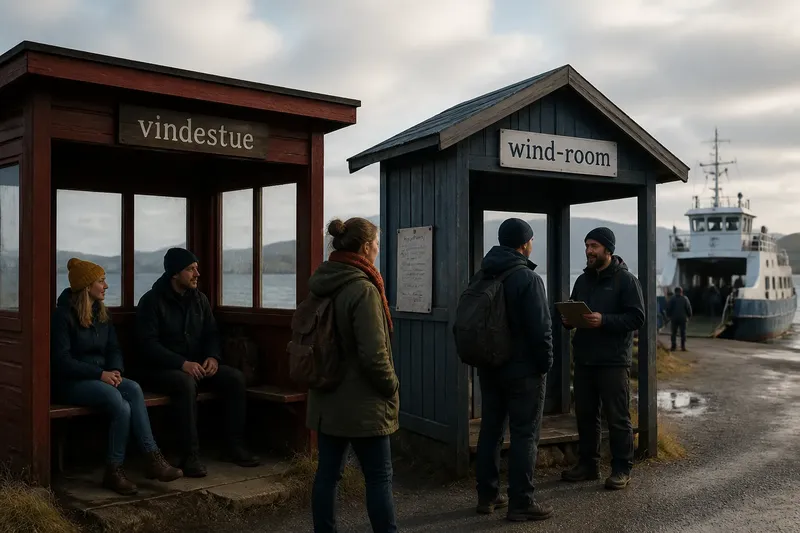
In Skeld, a visiting Aven ferry worker calls the shelter a vindestue, an invented Aven compound formed from vinde, “wind”, and stue, “room”. Skeld speakers begin using the full expression as vindestue. Over time, local pronunciation may adjust the sounds, and the word may acquire Skeld endings. That is borrowing: the expression’s material came across with the ferry worker, even if local speech made it more comfortable.
In Aven, meanwhile, travellers returning from Skeld call the same shelter a wind-room, using an invented Aven phrase built from their own words for “wind” and “room”. The expression follows the structure of Skeld’s established name for the shelter, but it does not import that name’s sounds. That is a calque: a foreign naming pattern has been reproduced with Aven vocabulary.
Suppose the Aven phrase then catches on among ferry staff and appears on a handwritten notice at the landing. The observable result is not merely that the communities possess different labels. Their labels preserve different evidence: vindestue points towards a word carried across, while wind-room points towards a translated model. Neither form alone tells us who first built the shelter, how long it has existed, or which community invented the expression. It records a linguistic route, not a complete social history.
What the forms preserve
The difference matters because words can travel independently of the things they name. A shelter, tool or custom may spread through trade, seasonal work, migration, schooling or ordinary conversation. A direct borrowing can preserve a recognisable sound from the language associated with that contact. A calque can show that speakers understood a foreign expression well enough to reproduce its internal structure.
In northern regions, where waterways and shore routes have long connected communities, both processes can occur in the same setting. A term used by boat crews might be borrowed in a port where people hear it repeatedly. Inland speakers, who encounter the idea through translated instructions or conversation, might instead make a calque. These are plausible pathways, not rules: contact does not dictate a single linguistic outcome.
A calque can be especially easy to mistake for an independent creation. If every element belongs to the local language, the expression may look self-explanatory. To identify a possible calque, a reader needs more than a neat resemblance between two phrases. The relevant questions include whether the expressions share a distinctive structure, whether their meanings line up, and whether there is a credible route of contact between the speakers.
Borrowings have their own disguises. A borrowed noun may take local plural endings or shift its stress; its spelling may be regularised by teachers, printers or later standardisation. A calque may also be only partial: one part is translated while another is retained. A dictionary’s label can help, but word histories often remain uncertain, and similar expressions may arise separately.
Reading the clues?
How can I tell a borrowing from a calque?
Look first at the word’s form: a borrowing usually carries some material from the source language, while a calque uses local words to mirror a source expression’s structure or meaning. Then check whether the proposed source and contact route are credible; resemblance by itself is not enough.
Can a word be both?
Yes. A compound can retain one imported element and translate another, or a borrowed word can later inspire a local translation. The categories describe different parts or stages of a word’s history, so a single expression need not fit one box neatly.
Do borrowed words keep their original meaning?
Not necessarily. A borrowed form may narrow, broaden or shift in meaning after entering a new language. Speakers use it within their own conversations and habits, rather than preserving a sealed copy of its source.
Can similar phrases prove direct contact?
No. Two languages can independently create comparable expressions from ordinary materials, especially for familiar objects or experiences. A persuasive account needs a distinctive match and a plausible history of contact, not just two phrases that translate neatly.
Following the route carefully
When you meet a possible borrowing or calque in a northern place-name, local account or conversation, separate what you can observe from what you infer. Note the exact forms and meanings, then ask whether the expression’s sounds or its internal structure seem to have travelled. A local speaker may also explain how the word is used now; present-day meaning matters even when the story of its arrival is unclear.
Next, consider the setting without forcing it into a single dramatic origin story. Ports, ferry landings, markets and workplaces can bring speakers together, but a place where contact was possible does not establish when a word entered use or who carried it. A careful account can say that a form resembles a borrowing or calque and identify what further evidence would clarify the link.
The invented ferry case leaves two distinct traces from one shared change. Skeld adopts the name as a word; Aven rebuilds its pattern from local materials. That is the useful distinction between borrowed words and calques: not two different kinds of contact, but two ways speakers make another language’s expression their own.
Listen for the form as well as the meaning. A familiar-sounding word may have crossed the water intact, while an entirely local phrase may carry a neighbour’s design. Keeping those possibilities separate makes a small vocabulary clue more informative—and keeps it from being asked to prove more history than it can bear.